New ATM center commissioned in Fergana Valley
One of Uzbekistan’s busiest and most critical air navigation hubs upgraded with a state-of-the-art ATC tower complex
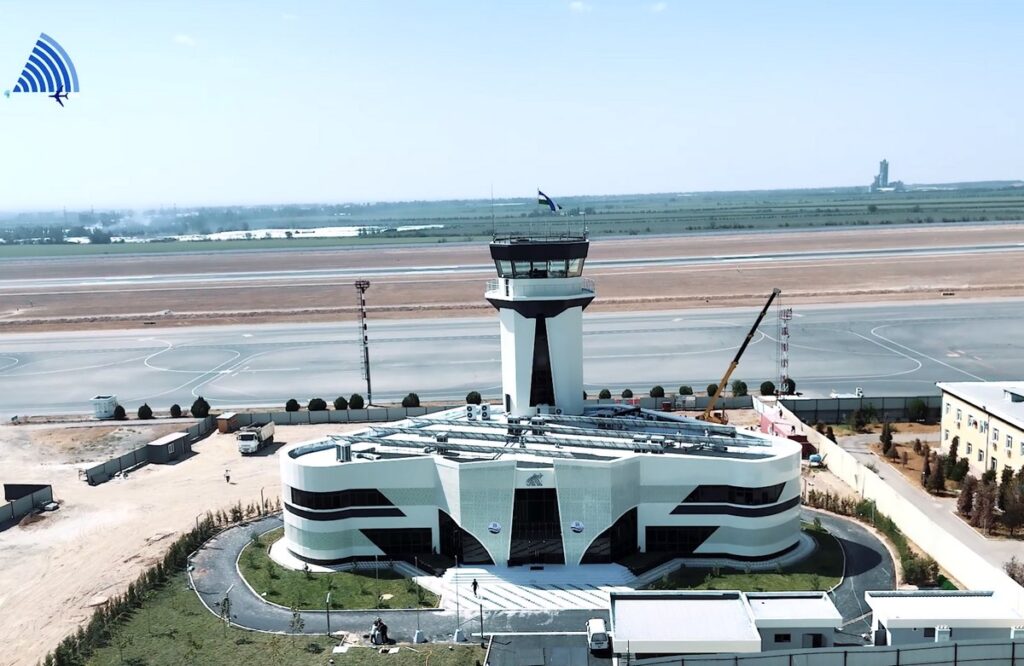

As part of a large-scale modernization of Uzbekistan’s Air Traffic Management (ATM) system, a new ATM center complex featuring a Control Tower (ATC tower / TWR) has been commissioned in Namangan.
According to the national air navigation service provider, Uzaeronavigatsiya, the Namangan ATM Center manages air traffic across an area of responsibility exceeding 22,000 square kilometers. The center’s air traffic controllers provide ATC services for aircraft departing and landing not only at Namangan Airport, but also at neighboring airfields in Fergana, Andijan, and Kokand, as well as flights to the Sokh exclave and Osh in Kyrgyzstan.
The airspace over the Fergana Valley encompasses 21 airways and 8 international entry/exit points connecting Uzbekistan with neighboring states. This positions the Namangan Center as a key strategic link within the national ATM framework.
The new facility features fully modernized radio equipment, advanced surveillance and tracking systems, digital communications, and a European-manufactured automated ATM system. Uzaeronavigatsiya emphasized that the upgraded equipment elevates the accuracy and safety of air navigation services to a new standard.
The two-story, 1,500-square-meter complex houses administrative, engineering, and operational personnel. Constructed closer to the runway and apron, the control tower provides controllers with a significantly improved visual line of sight over aircraft operating in the maneuvering area.
Designed and built with eco-friendly materials, the complex includes an on-site solar power station capable of supplying up to 50% of the facility’s daily electricity needs.
Uzbekistan is experiencing a steady surge in transit traffic along Asia–Europe air corridors connecting Europe with China, Hong Kong, South Korea, and Japan. This growth stems from a broader rerouting of global air traffic driven by the closure of Ukrainian airspace, restrictions over parts of Russian airspace, and ongoing tensions in the Middle East. As carriers seek alternative southern routes, the transit airspace of Kazakhstan, Uzbekistan, and Turkmenistan has become an essential corridor for East–West transcontinental flights.