
Air Astana to boost its Boeing 787 order to 18 aircraft
Kazakh airline's largest-ever commitment highlights Central Asia's rising role in global aviation
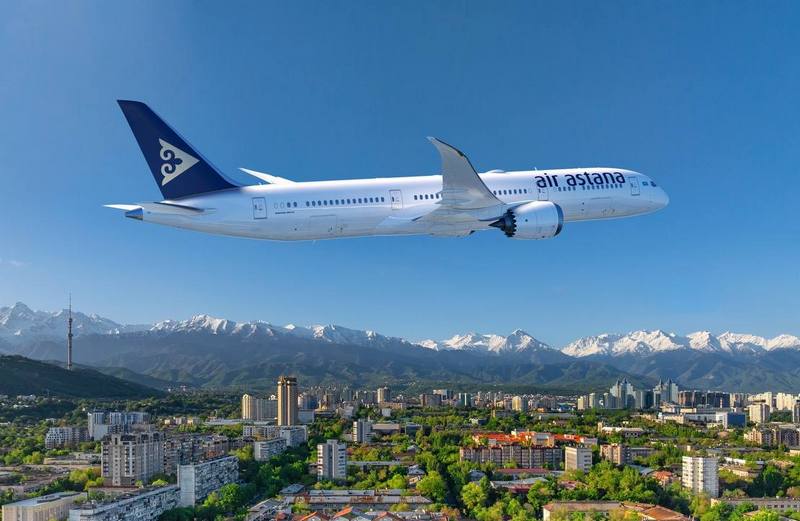

Kazakhstan’s largest carrier, Air Astana, will place an additional order for Boeing 787-9 long-haul aircraft. A preliminary agreement on this was signed today at the meeting of Central Asian leaders with the U.S. President in Washington (the C5+1 Summit), Boeing said.
Once finalized, the order will be Air Astana’s largest single aircraft purchase, with it comprising of five firm positions, five options and five purchase rights.
The newly ordered aircraft will be delivered between 2032 and 2035.
The airline will leverage the 787-9, which will seat 303 passengers, to grow capacity across its existing routes and enable expansion into North America.
“Air Astana is strategically committed to boosting its service capabilities from Central Asia / Caucasus to Asia, Europe and the rest of the world over the next decade, with the arrival of the first Boeing 787-9 Dreamliner next year marking the start of this exciting phase of development,”
In 2022, the Kazakh carrier already ordered three Boeing 787-9 airliners from the US-based Air Lease Corporation. Initially, they were scheduled to arrive in 2025–2026 to replace three Boeing 767-300s. In September, Foster confirmed that the delivery of the first two 787-9s is expected in August and September 2026, with the last one coming in March 2027.
The total value of the 18 Boeing 787-9 aircraft fleet including engines is US$7 billion based on manufacturer list prices.
The delay in the delivery of the earlier ordered 787 forced the airline to start using Airbus A321neoLR narrowbody aircraft with extended range on some long-haul routes and postpone the launch of flights to New York. Foster has recently admitted that due to the necessity to avoid Russian airspace, the range of the Boeing 787-9 would not be sufficient for a non-stop transatlantic flight.
Follow us on social media

Editor’s Choice
-
Royal Jordanian to launch flights to Tashkent from June 30
AirlinesNews -
Termez becomes sixth Uzbek gateway to Istanbul
AirlinesAirportsNews -
Azerbaijan-Pakistan air connectivity expands as third carrier enters market
AirlinesAirportsNews -
Uzbekistan Airways Technics performs inaugural on-wing testing of GEnx-1B engine
AirlinesMRONews
Editor’s Choice
-
Royal Jordanian to launch flights to Tashkent from June 30
AirlinesNews -
Termez becomes sixth Uzbek gateway to Istanbul
AirlinesAirportsNews -
Azerbaijan-Pakistan air connectivity expands as third carrier enters market
AirlinesAirportsNews -
Uzbekistan Airways Technics performs inaugural on-wing testing of GEnx-1B engine
AirlinesMRONews