
Who is designing Central Asia’s aviation map?
China has become one of the fastest-growing international markets for Central Asian aviation
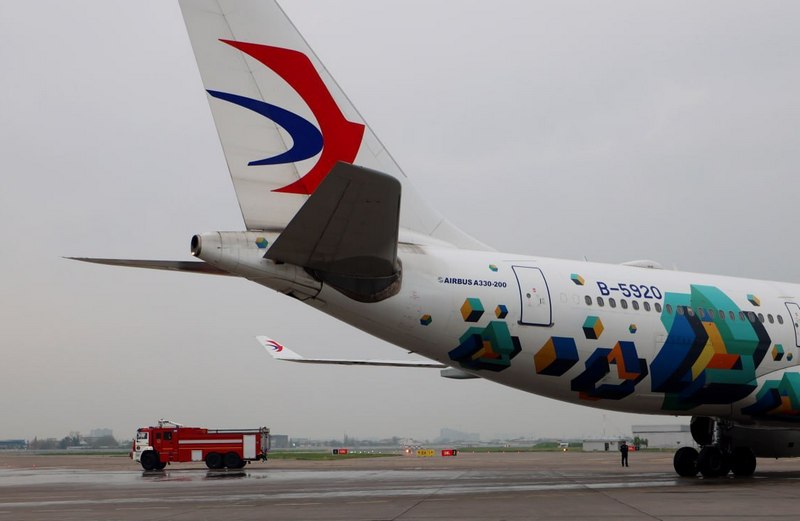

Over the past two years, China has become one of the fastest-growing international markets for Central Asian aviation. New services are appearing almost every month, frequencies are increasing, and Chinese airlines are entering markets where until recently they had little or no presence.
But if we look only at route maps, part of the story remains hidden. Today, Tajikistan has no year-round scheduled China service operated by a Tajik carrier. In Kyrgyzstan, the past two seasons have brought Air China from Beijing, China Southern from Guangzhou and the regional Kashgar–Osh service. Over the same period, Uzbekistan Airways expanded its Chinese network from two cities to five: Guangzhou, Hangzhou and Shenzhen joined Beijing and Urumqi.
On a route map, the picture looks fairly balanced: both sides are adding destinations. But instead of counting routes, let’s consider only Chinese airports that can be reached from Tashkent at least three days a week. A once-weekly flight certainly exists, but passengers have to plan their trip around it. Three or four operating days a week already amount to a usable transport link.
In summer 2024, Chinese airlines had roughly two such gateways from Tashkent — Beijing Daxing and Urumqi. By summer 2026, two became six: Daxing, Urumqi, Guangzhou, Xi’an, Shanghai and Beijing Capital.
The estimate is deliberately conservative: every ambiguous case in summer 2024 was counted in favour of the earlier period so as not to overstate the growth.
Uzbekistan Airways’ route map changed substantially over the same two years, but its frequency map barely did. Guangzhou operates once a week, Hangzhou twice, Shenzhen once. None of the three new destinations meets the same frequency threshold. Private carrier Centrum Air also serves China and is actively developing its agency sales there, but its Guangzhou service currently operates at roughly the same low frequency.
The divergence is striking. Local carriers are expanding their geography. Chinese carriers are adding destinations while rapidly turning them into regular gateways. That may matter more today than the sheer number of new routes.
Not all access is equal
Frequency matters for another reason. For a Chinese airline, Beijing, Shanghai, Guangzhou, Xi’an or Urumqi are not simply destinations. They are entry points into its domestic network.
For a foreign carrier, the situation is more complicated. An airline can obtain traffic rights, launch a route and deploy an aircraft — and still remain only at the edge of the Chinese market. Formal access to China and real access to the Chinese passenger are not the same thing.
In practice, there are at least three different barriers. First comes the right to fly: bilateral agreements, traffic entitlements and carrier designation. Then comes the ability to exercise those rights: slots, workable arrival times, sufficient frequency and air corridors. Finally, there is the commercial layer — sales inside China, the agency network, domestic onward connections and the purchasing channels Chinese passengers actually use. It is at the latter two levels that formal parity begins to diverge noticeably from actual market power.
Slots are a good example. Market participants regularly cite them as one of the practical constraints on expanding China services. The reasons behind individual decisions on the Chinese side are not publicly explained, so it would be wrong to draw sweeping conclusions from them. But the issue itself is very real: during the July negotiations, Kazakhstan separately raised the allocation of slots for its carriers with the CAAC, alongside access to Chinese airspace and a third international air corridor.
Once slots and air corridors appear on the agenda alongside traffic frequencies, the bilateral entitlement alone no longer explains the market.
Distribution is another story. The Chinese aviation IT-provider TravelSky works with foreign airlines, but the domestic distribution remains an ecosystem with its own logic, agency infrastructure and cost of entry. For a Chinese airline, this is its home environment. For a foreign carrier, it is another layer of complexity after obtaining traffic rights and a slot.
And TravelSky is only one layer of China’s distribution ecosystem. Reaching the Chinese passenger still requires access to local OTAs, super-apps and agency channels — an environment that is considerably less familiar to a foreign carrier than to a domestic airline.
There is also a more practical industry observation: non-Chinese airlines often sell China more effectively in their home markets than they do inside China itself. A Kazakh airline is strong in Kazakhstan; an Uzbek airline is strong in Uzbekistan. A Chinese carrier has a natural advantage in the opposite direction and can also draw passengers from dozens of domestic Chinese cities.
There is no comparable public dataset on passenger nationality and point of sale, so attaching percentages to this would be speculation. But it is already clear that an equal share of seats does not necessarily mean equal access to the market.
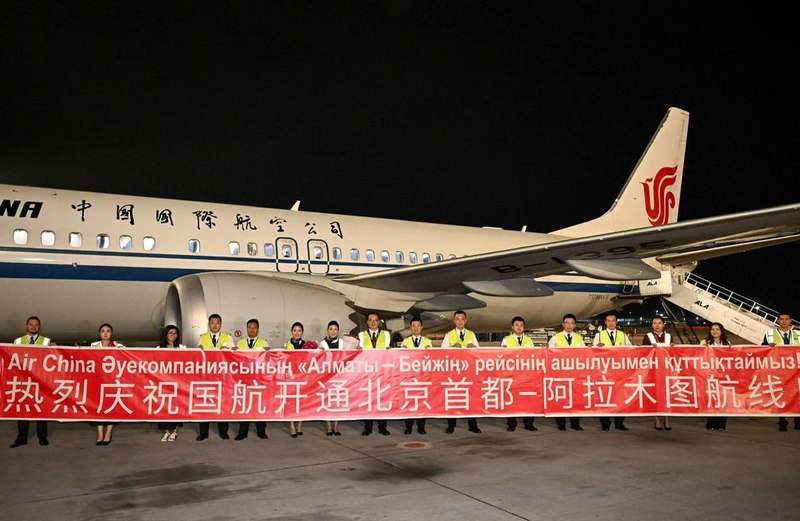
Photo: Almaty Airport
Kazakhstan: there is a response
Kazakhstan is particularly interesting because Chinese expansion began there earlier, giving local carriers time to build a comparable response.
The market is now close to balanced. Of roughly 1.09 million seats in the summer season, around 53% are operated by Chinese airlines. At the same time, Air Astana increased its China capacity by 63% year on year, while FlyArystan grew by 163%.
Kazakhstan is precisely what prevents this story from being reduced to the simplistic formula that Chinese networks are pushing out local carriers.
Air Astana is responding with mainline services: Shanghai since March and a second Guangzhou service from Astana since June. SCAT has gone as far as exercising seventh-freedom rights on the Sanya–Prague route.
FlyArystan is responding at another level. In a year and a half, the low-cost carrier has built a six-route China program. Four routes are already operating: Almaty–Yining, Astana–Urumqi, Aktau–Urumqi and Almaty–Xi’an. Two more have been announced: Almaty–Chongqing and Astana–Yining.
Our own frequency filter does not yet admit the entire programme: some of the new routes operate only twice a week. But Yining — also known as Kulja — already meets our gateway frequency threshold. That is particularly interesting because, in China’s own network logic, Yining is one of Xinjiang province’s secondary hubs, yet the Kazakh carrier entered it before Urumqi Airlines began discussing its own services between Kulja and Kazakhstan.
The architecture of the emerging network is indeed being shaped to a significant extent from the Chinese side. But airlines on both sides of the border can use that architecture. The question of who designs the map should be separated from the question of who flies on it.
Kazakhstan offers another clue. In July, the two sides raised the weekly traffic entitlement from 124 to 152 flights. Yet the same negotiations also covered airport slots, airspace access and a third international corridor. Competition is gradually shifting from obtaining the right to operate a flight to being able to use that right effectively.
And the network effect is already visible in the numbers. As early as summer 2024, a China Southern representative said that almost 58% of passengers on its Urumqi services to and from Almaty and Astana continued their journeys beyond Urumqi.
This figure covers only two routes, one airline and a specific period, so it cannot be extrapolated to the entire market. But it says something important about Urumqi’s role: a significant share of those passengers are not really buying Urumqi. They are buying the network behind it.
No secret plan
There is no need to look for some hidden Chinese master plan. CAAC uses the formula 干支通、全网联 — roughly, “trunk–regional connectivity and whole-network integration.” In practice, the model links trunk routes, regional services and the connections between them into a single network.
For Xinjiang province which neighbors Central Asia, the logic is quite explicit. Urumqi is the primary hub. Kashgar and Yining are next-tier hubs. One of the stated development directions is international connectivity with Central Asia.
In parallel, Chengdu Airlines is building a regional C909 network within Xinjiang. By June 2026, more than sixty routes in the region were already being operated with the type.
What is more interesting is that this domestic logic is gradually ceasing to stop at the national border. In April, a C909 began flying from Kashgar to Osh. Khujand followed. Urumqi Airlines is discussing Karaganda, Almaty and Astana. The Kazakh side is suggesting that the conversation go further — to Oskemen, Semey and, in the longer term, Zaysan and Katon-Karagay.
In my view, the C909 regional jet is not the cause of the process. It is better understood as a convenient tool for routes where a larger aircraft would be excessive.
A similar pattern is emerging on another Chinese border. Chengdu Airlines has begun operating regional C909 services between Khabarovsk, Harbin and Jiamusi and is considering further expansion across the Russian Far East.
There is no convenient name for this phenomenon yet. I call it the shifting network frontier. China’s political border remains exactly where it is. But the line to which the logic of its aviation network extends is gradually moving farther west. From the top, it is being pushed by Beijing, Shanghai, Guangzhou and Xi’an. From below, by Urumqi, Kashgar and Kulja.
Central Asian markets are simply at different stages of this process:
- In Tajikistan, the Chinese side controls the entire year-round scheduled network to China.
- In Kyrgyzstan, new connections are appearing at several levels at once — from Beijing and Guangzhou down to Kashgar.
- Uzbekistan shows particularly clearly the difference between the number of new routes and the frequency at which they operate.
- Kazakhstan shows that a local airline can adapt to the new network geography and use it to its own advantage.
- Turkmenistan remains a useful contrast: geographic proximity to China alone is clearly not enough.
Why now?
For Kazakhstan and Uzbekistan, China is already regarded as one of the principal markets for further international growth. The problems in the Gulf did not create this trend — it began earlier — but they have made it significantly more important.
If some of the established flows through Dubai and the wider region become less predictable, airlines have to look for other large markets. In that context, China is an almost obvious candidate.
But launching a flight is not enough. An airline needs a workable slot, sufficient frequency, a suitable arrival time, sales capability on the Chinese side and the ability to carry passengers onward.
That is why the July codeshare between Uzbekistan Airways and China Southern is interesting. Formally, it is a conventional commercial agreement. From a network perspective, it is almost a test of the entire argument.
If Uzbekistan Airways gains not only domestic onward connections through its partner but also meaningful visibility at the Chinese point of sale, it could close a substantial part of the network-access gap without opening dozens of routes of its own. If the access stops at the mainline sectors, the effect will be very different.
The real question, then, is no longer simply who flies between Tashkent and China. It is which system the passenger gains access to after arrival.
So who is designing the map?
If I had to answer that question today, in August 2026, I would put it this way: the architecture of the market is increasingly being shaped from the Chinese side.
But that certainly does not mean that only Chinese airlines will benefit from it. Kazakhstan already demonstrates the opposite. The network designer and the airline that learns to use that network do not have to be the same player.
That is why what is happening in Central Asia is more interesting than a conventional story of Chinese expansion. The real question is how quickly Central Asian airlines learn to operate within this new network geography — securing the right slots, selling effectively inside China, connecting to their partners’ domestic networks and turning isolated routes into regular gateways.
There is a cargo side to this story as well. The Urumqi–Zurich freighter already uses Tashkent for a technical stop, while My Freighter is active between Tashkent and Urumqi. But the cargo map deserves a separate discussion.
The passenger hypothesis is easier to test.If the network frontier really continues to move, by summer 2027 we should see new second-tier routes from Urumqi and Kulja, additional international C909 services, and codeshare agreements extending further into China’s domestic network. We may even see the first locally based C909 operator in Central Asia.
If none of this happens, then perhaps a collection of unrelated facts simply aligned too neatly into an attractive theory. Let’s return to this article in summer 2027. For now, timetables tell us more about the market than route maps do.
Don't miss our articles — subscribe
Key commercial aviation news from Central Asia and the South Caucasus — once a week, in your inbox.
Editor’s Choice
-
Passenger traffic between Kazakhstan and Uzbekistan surges over 30%
AirlinesAirportsNews -
Kazakh authorities cut country’s fleet growth forecast by 25%
AirlinesNews -
Kazakhstan’s air transport market: structural constraints, Kaspi and the shadow of Tashkent
AirlinesAirportsInsightsITMRO -
Kazakhstan’s air transport market: Three players and the capacity surplus window
AirlinesInsightsMRO
Editor’s Choice
-
Passenger traffic between Kazakhstan and Uzbekistan surges over 30%
AirlinesAirportsNews -
Kazakh authorities cut country’s fleet growth forecast by 25%
AirlinesNews -
Kazakhstan’s air transport market: structural constraints, Kaspi and the shadow of Tashkent
AirlinesAirportsInsightsITMRO -
Kazakhstan’s air transport market: Three players and the capacity surplus window
AirlinesInsightsMRO