
Uzbekistan airports report 13% surge in passenger traffic and 27% jump in cargo over first three quarters
Airports across Uzbekistan processed over 12.6 million passengers between January and September 2026
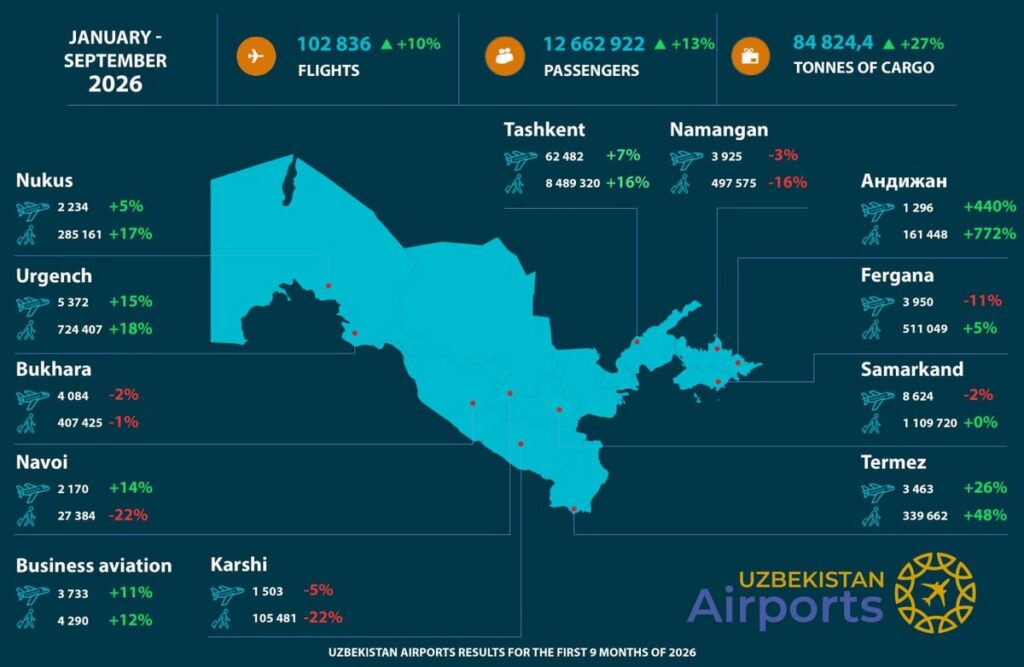


Despite geopolitical headwinds that led to reduced frequencies and selective route suspensions by international carriers, Uzbekistan airports maintained robust operational momentum across all core metrics—passenger traffic, aircraft movements, and freight throughput—during the first nine months of 2026.
Data released by state operator Uzbekistan Airports shows aggregate passenger traffic reaching 12.663 million from January through September, representing a 13% year-on-year increase. International sectors accounted for 10.361 million passengers (up 13% YoY), while domestic traffic outstripped cross-border growth, climbing 15% YoY to 2.302 million passengers.
Total aircraft movements across Central Asia’s most populous nation’s airports rose 10% YoY to 102,840 flights. International air services generated 71,620 movements (+8% YoY), while domestic flight operations expanded to 31,210 movements (+17% YoY).
Tashkent International Airport (TAS) reinforced its status as country’s largest, handling 8.489 million passengers (+16% YoY) and 62,480 flight movements. The top five airport network was completed by Samarkand (SKD), Urgench (UGC), Fergana (FEG), and Namangan (NMA).
Uzbekistan airports (9 months 2026)
| Airport | Traffic, passengers (Y-on-Y) | Number of Flights (Y-on-Y) |
|---|---|---|
| Tashkent |
8 489 320 (+16%) |
62 482 (+7%) |
| Samarkand |
1 109 720 (+0%) |
8 624 (-2%) |
| Urgench |
724 407 (+18%) |
5 372 (+15%) |
| Fergana |
511 049 (+5%) |
3 950 (-11%) |
| Namangan |
497 575 (-16%) |
3 925 (-3%) |
| Bukhara |
407 425 (-1%) |
4 084 (-2%) |
| Termez |
339 662 (+48%) |
3 463 (+26%) |
| Nukus |
285 161 (+17%) |
2 234 (+5%) |
| Andijan |
161 448 (+772%) |
1 296 (+440%) |
| Karshi |
105 481 (-22%) |
1 503 (-5%) |
| Navoi |
27 384 (-22%) |
2 170 (+14%) |
Regional infrastructure saw several standout operational gains. Passenger traffic at Andijan (AZN) surged 8.7-fold, reflecting a sharp low-base recovery following the resumption of commercial flights in late March 2025 after an extensive airfield modernization project. Termez (TMJ) posted a 48% traffic increase, propelled by expanding Umrah pilgrimage charter operations and the entry of Saudi low-cost carrier Flyadeal—a route that also captured spillover demand from neighboring Central Asian markets. Infrastructure capacity additions in Urgench (+18% YoY) and Nukus (+17% YoY) were sustained by new international route launches.
Conversely, traffic contracted at select regional hubs, falling 16% YoY in Namangan and 22% YoY in Karshi (KSQ). Management attributed these declines to network realignments, shifting demand profiles, and schedule rationalization by operating airlines adjusting to geopolitical factors. Navoi International Airport (NVI) further consolidated its transition toward dedicated freight operations: despite a 22% drop in passenger volume, total movement counts expanded 14% YoY alongside higher cargo processing throughput. Passenger volumes at Bukhara (BHK) dipped 1% YoY.
Air freight throughput recorded strong double-digit expansion network-wide, processing 84,820 metric tons of cargo and mail—a 27% gain compared to the same period in 2025. Tashkent served as the primary gateway, absorbing the bulk of volume at 78,870 metric tons.
Business aviation activity also maintained an upward trajectory, executing 3,730 movements (+11% YoY) and transporting 4,290 high-net-worth and executive passengers.
Don't miss our articles — subscribe
Key commercial aviation news from Central Asia and the South Caucasus — once a week, in your inbox.


Editor’s Choice
-
Jiangxi Cargo to Launch Nanjing–Tashkent Freighter Route
AirlinesAirportsCargoNews -
China–EU Multimodal Cargo Corridor Opens via Tashkent
AirlinesAirportsCargoNews -
Kyrgyz carrier resumes operations on Bishkek–Tashkent route
AirlinesAirportsNews -
Etihad Airways begins operations in Uzbekistan
AirlinesAirportsNews